Film Review: Fail Safe (1964)

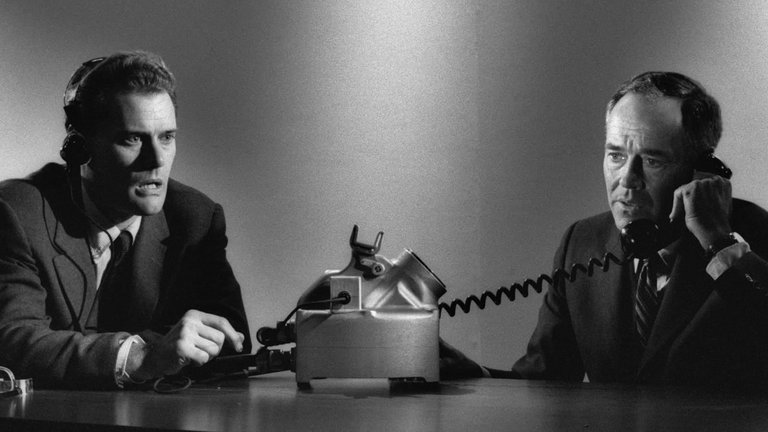
If good films are to be recognised as such, they must be good, but sometimes it is even more important for their makers to get lucky. Luck was something the people behind Fail Safe, the 1964 political drama directed by Sidney Lumet, lacked, and, as a result, a film that was supposed to be a powerful exploration of the most pressing issue of its time and an instant classic instead got relegated to a footnote, now known only to the more hardcore among cinephiles.
The film is based on the 1962 novel by Eugene Burdick and Harvey Wheeler. The plot deals with the Cold War, which was at its peak, risking escalation into an actual armed conflict between the United States and the Soviet Union. The main thing that prevented this was the concept of Mutually Assured Destruction – both sides, thanks to advanced and unimaginably destructive nuclear weapons, possessed the ability to inflict such damage on each other that any notion of victory would have been pointless and the aftermath would mean not only the end of civilisation but of humanity itself. The unimaginable, however, starts to happen one day when USAF early-warning radar detects an unknown object that has entered American airspace. Although routine, such events trigger a response in the form of Vindicators, American supersonic bombers, advancing to so-called “fail-safe” positions from which they would, if they receive the adequate order, attack the Soviet Union with twenty-megaton hydrogen bombs. The alarm appears to be false and the bombers are ordered to return to their regular position. General Bogan (played by Frank Overton), much to his horror, learns that a communication system malfunctioned and that, due to a computer error, Colonel Jack Grady (played by Edward Binns), commander of one of the squadrons, misinterpreted the order and continued with his mission, believing that war had actually started. After attempts to make him return fail, the President of the United States (played by Henry Fonda) is informed about the increasing possibility that the bombers will destroy Moscow and thus trigger a Soviet retaliatory strike and US counter-strike, resulting in a nuclear holocaust. The President, through his trusted translator Buck (played by Larry Hagman), contacts the Soviet prime minister and tries to prevent catastrophe by offering co-operation, even if it means helping the Soviets to shoot down US bombers. When everything fails and the fate of Moscow seems sealed, the President comes up with a heartbreakingly drastic way to save humanity.
At first, it looked like luck would smile on Lumet, who produced the film together with Charles H. Maguire and Max E. Youngstein. The original novel had been published during the Cuban Missile Crisis, making its content as relevant to the audience as humanly possible and guaranteeing huge publicity to any future film adaptation. However, it turned out that the plot of Fail Safe bore a striking similarity to Red Alert, a 1958 novel by Peter George, which was simultaneously being adapted for the screen by Stanley Kubrick. The issue led to a plagiarism lawsuit which was quickly settled in a way that Fail Safe could proceed with production, but only if it was released after Kubrick’s film, which ultimately became Dr. Strangelove, one of the most legendary films of its time. In order to make his film as different as possible from Lumet’s, Kubrick decided to turn his into a satirical dark comedy, and his approach appealed to the audience, which was more eager to handle a dark and disturbing subject if coated with dark humour. Fail Safe, on the other hand, played as a straight and completely serious drama, resulting not only in failure at the box office but also in inevitable comparisons with Kubrick’s work, making it a disappointment even among critics.
The sad fate of Fail Safe was hardly deserved. On its own, it is a very good film that actually tries to explore issues of war and peace, runaway technology, and human frailty, with the latter two conspiring to trigger a nuclear apocalypse by accident. Lumet took this challenge very seriously and directed the film in a manner very similar to the classic television plays on which he had previously learned his craft. Almost all the plot takes place in interiors, and the seriousness of the situations is underlined by the lack of music, which allows the actors to create tension by themselves. The cast includes some notable names, including Walter Matthau as Professor Groeteschele, a Strangelovian Pentagon advisor – a civilian hawk who believes that nuclear war could be limited and actually won – unlike the dovish General Black (played by Dan O’Herlihy) who actually wants to stop the madness. But it is Henry Fonda who truly shines, playing a wise, peaceful, and resourceful President of the United States who represents the embodiment of all American ideals, at least those adopted by left-wingers and liberals like Lumet. Larry Hagman, who would later become successful on television, is effective in the role of the translator.
Fail Safe is, however, far from perfect. The plot begins very slowly, with some scenes that are too confusing or look redundant. Ilsa Woolfe, a socialite who actually seems sexually aroused by the talk of nuclear holocaust, appears to belong to a different film, although Lumet probably felt compelled to introduce an eye-candy character, to be played by popular fashion model Nancy Berg. With the US military refusing to offer help, Lumet had to display aircraft with the help of stock footage that doesn’t look particularly convincing and makes Fail Safe look dated. Some of the dialogue is too preachy, and some of the plot elements are too melodramatic and too convenient. But the film nevertheless looks powerful, especially now when we know that situations like those depicted in the film actually happened during the Cold War, only to be defused by a number of individuals who fortunately made the proper decisions. Today, when the quality of people that sit in the world’s decision centres appears to be incomparably worse than sixty years ago, Fail Safe looks perhaps even more disturbing than it did when it premiered. In 2000, Steven Soderbergh directed a remake in the form of a live television play.
RATING: 7/10 (+++)
Blog in Croatian https://draxblog.com
Blog in English https://draxreview.wordpress.com/
InLeo blog https://inleo.io/@drax.leo
InLeo: https://inleo.io/signup?referral=drax.leo
Unstoppable Domains: https://unstoppabledomains.com/?ref=3fc23fRc42c1b417
Hiveonboard: https://hiveonboard.com?ref=drax y
Bitcoin Lightning HIVE donations: https://v4v.app/v1/lnurlp/qrcode/drax
Rising Star game: https://www.risingstargame.com?referrer=drax
1Inch: https://1inch.exchange/#/r/0x83823d8CCB74F828148258BB4457642124b1328e
BTC donations: 1EWxiMiP6iiG9rger3NuUSd6HByaxQWafG
ETH donations: 0xB305F144323b99e6f8b1d66f5D7DE78B498C32A7
Posted using CineTV