Film Review: She Wore a Yellow Ribbon (1949)

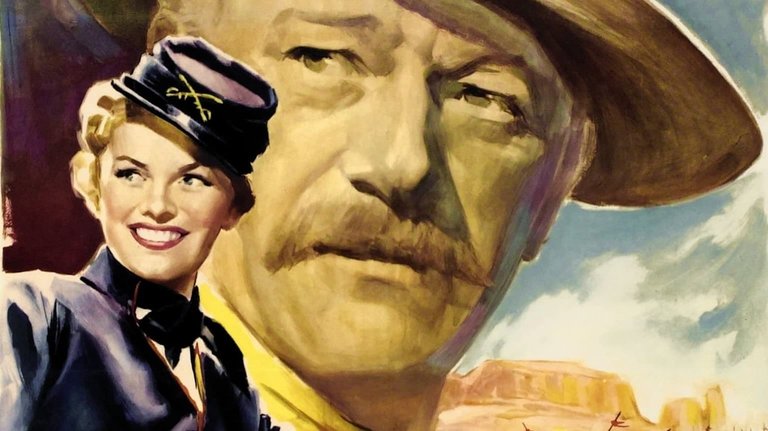
A dedicated but world-weary professional having to face his greatest challenge days or weeks before retirement is a Hollywood trope popular in action films or police thrillers. A long time ago it was popular in westerns, and one of the most notable examples is provided by the protagonist of She Wore a Yellow Ribbon, the 1949 film directed by John Ford.
After forty years of service, US Army Captain Nathan Brittles (played by John Wayne) is about to retire and leave Fort Starke, a small outpost in the US Southwest where he had served as a cavalry officer. However, it is the summer of 1876 and the news about Custer’s catastrophic defeat at Little Big Horn has reached many of the Indian tribes, whose hot-headed young braves decide to leave reservations, band together and start a holy war that would chase white people from their ancient lands.
Brittles is ordered by Major Mack Allshard (played by George O’Brien), his friend and commanding officer, to escort his wife Abby (played by Mildred Natwick) and beautiful niece Olivia Dandridge (played by Joanne Dru) to a more secure area. The mission might get complicated, because the flirty Olivia has deliberately worn a yellow ribbon as a sign that she fancies one of the men in Brittles’ unit, creating a romantic rivalry between Lieutenant Cohill (played by John Agar) and Lieutenant Pennell (played by Harry Carey Jr.).
She Wore a Yellow Ribbon represents the second part of Ford’s “Cavalry trilogy”, which started with Fort Apache a year before and ended with Rio Grande a year later. It also represents the first of Ford’s westerns made in colour, which, with the help of cinematographer Winton C. Hoch, one of the developers of Technicolor technology, makes it one of the more visually appealing among Ford’s films.
Ford again used his favourite locations of Monument Valley, creating memorable images, accompanied by a likeable score by Richard Hageman that uses motifs of popular 19th‑century music, including the eponymous title song.
The most attractive and the most valuable element of She Wore a Yellow Ribbon is, however, John Wayne. Although he had worked with Wayne before, it was his brilliant performance in Hawks’ Red River one year earlier that had convinced Ford that he could actually act in complex and more demanding roles. In this film Wayne plays a character at least a decade or two older than himself, faced with conflicting emotions that come with the realisation that he must abandon something to which he has dedicated his entire life. Wayne is great in handling his hot‑headed subordinates, making important decisions and conducting last‑ditch diplomacy that is to prevent unnecessary bloodshed. Wayne stated many years later that he considered the role of Captain Brittles one of the top in his impressive filmography, and it is difficult not to agree with that assessment.
Wayne’s achievement is even greater in light of the fact that the plot of She Wore a Yellow Ribbon actually isn’t anything to write home about. Wayne is surrounded by some fine acting talent that includes veteran character actor Victor McLaglen in the role of hard‑drinking Sergeant Quincannon and young Ben Johnson as Sergeant Tyree, who appears to be Brittles’ natural heir. Ford directs the film with ease, but the plot seems weak and there is even relatively little action for western standards. One scene in the middle, on the other hand, features a scene of torture that looks quite graphic and unpleasant for the standards of 1940s Hollywood.
Some of today’s audience might be appalled by the paternalistic attitudes towards Native Americans, especially in the scene during which elderly Chief John Big Tree, in the role of an Arapaho leader, meets with Wayne’s character. Ford and his scriptwriters, to their credit, manage to stray out of western clichés by ending the film on a peaceful note. She Wore a Yellow Ribbon might have been a proper classic if it ended with the protagonist literally riding into the sunset, but Ford instead opted to prolong the film with an unnecessary deus ex machina development that looks a little bit too Hollywood.
Despite this and other shortcomings, and despite not being among Ford’s best works, She Wore a Yellow Ribbon deserves recommendation as a good example of a western made in the golden age of the genre.
RATING: 6/10 (++)
Blog in Croatian https://draxblog.com
Blog in English https://draxreview.wordpress.com/
InLeo blog https://inleo.io/@drax.leo
InLeo: https://inleo.io/signup?referral=drax.leo
Unstoppable Domains: https://unstoppabledomains.com/?ref=3fc23fc42c1b417
Hiveonboard: https://hiveonboard.com?ref=drax y
Bitcoin Lightning HIVE donations: https://v4v.app/v1/lnurlp/qrcode/drax
Rising Star game: https://www.risingstargame.com?referrer=drax
1Inch: https://1inch.exchange/#/r/0x83823d8CCB74F828148258BB4457642124b1328e
BTC donations: 1EWxiMiP6iiG9rger3NuUSd6HByaxQWafG
ETH donations: 0xB305F144323b99e6f8b1d66f5D7DE78B498C32A7
Posted using CineTV