Film Review: The Covered Wagon (1923)

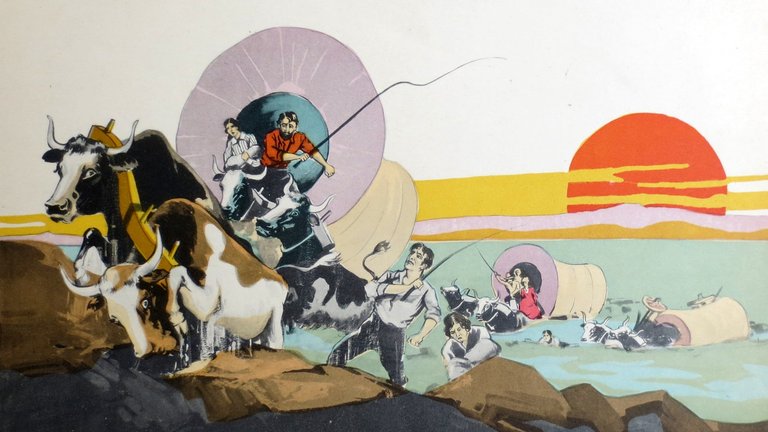
Western is considered the most American of all film genres. It is also the most genuine of all Hollywood products, with early California filmmakers often seeing themselves as spiritual heirs of intrepid pioneers who conquered the American West a generation or two earlier. Yet, in the first years of Hollywood, the genre was often looked down upon as 'pulpy' even by those critics who had abandoned their early snobbish scepticism towards film as an art. All that changed in 1923 with The Covered Wagon, a silent film directed by James Cruze, known as the first Western epic.
The film represents an adaptation of the popular 1922 novel by Emerson Hough. The plot begins in May 1848 when thousands of settlers, who had been gathering from the eastern parts of the United States, are coming to Westport Landing (today's Kansas City, Missouri) in order to begin a grand journey towards Oregon where they hope to begin a new and prosperous life. The large caravan is led by elderly and authoritative Jesse Wingate (played by Charles Ogle) who has brought two men with experience in the West to help him – Sam Woodhull (played by Alan Hale) and Mexican War veteran Will Banion (played by J. Warren Kerrigan). Those two men soon begin to differ on the ways to handle various obstacles on their way, but a further cause of discord is their romantic rivalry over Wingate's beautiful daughter Molly (played by Lois Wilson). She prefers dashing and chivalrous Banion, but decides to marry Woodhull after learning that Banion has been thrown out of the US Army for stealing cattle. In the meantime, the caravan has to endure difficulties with crossing rivers, hunger, cold, Indian attacks and greed that makes some of the participants leave for California after learning about recently discovered gold deposits.
The Covered Wagon is one of the most authentic among all grand Westerns. This is due to Paramount Pictures, in order to recreate scenes of hundreds of wagons moving across the prairies westwards, approaching families of actual settlers and asking them to lend real wagons, many of them actually still being used or kept as family heirlooms. This made possible the scene of the caravan crossing the Platte River, one of the most spectacular scenes in the history of American silent cinema, just as well as the scene depicting the caravan defending itself from the attack of hundreds of Indians later in the film. Indians were, unlike with many Westerns before and afterwards, played by actual Native Americans, in this case Arapahos from Wind River Indian Reservation, recruited by cowboy and part-time Hollywood actor Tim McCoy who, thanks to his knowledge of the Arapaho language, also served as interpreter for the cast and crew. Director James Cruze, on the other hand, had to rely on his ingenuity and various tricks in order to reconstruct scenes of buffalo hunting, since bison had nearly become extinct during the Wild West era and it took decades of conservation effort for their population to rise again. An interesting detail of the film is the use of the popular song 'Oh Susanna' in the film; not discouraged by the film being silent, Cruze simply displays sheet music on the screen.
Those spectacular scenes are held together by a simple but effective melodramatic plot that employs a simple distinction between chivalrous Banion and villainous Woodhull. Those characters are played by matinee idol J. Warren Kerrigan (whose career soon afterwards ended due to a face-wrecking car accident) and Alan Hale (who would later have a good career as character actor in the sound era), while Lois Wilson plays her character within the melodramatic parameters of silent cinema. What is refreshing is the use of comic relief in the form of Banion's trapper friend William Jackson (played by the old Scottish actor Ernest Torrence) and the real-life historical figure James Bridger. The latter is very enthusiastically played by elderly Tully Marshall and this character becomes a much more memorable figure than the stereotypical protagonists.
Cruze's film required a huge budget from Paramount Pictures, but the gamble more than paid off. The film was enthusiastically embraced by the public, including US President Warren G. Harding, and became a big hit. Its success proved that Westerns can be grand films and the next year rival studio Fox Pictures made their own Western epic The Iron Horse, a film that would become one of the first great works of John Ford, the director most associated with the genre.
RATING: 7/10 (+++)
_
Blog in Croatian https://draxblog.com
Blog in English https://draxreview.wordpress.com/
InLeo blog https://inleo.io/@drax.leo
InLeo: https://inleo.io/signup?referral=drax.leo
Unstoppable Domains: https://unstoppabledomains.com/?ref=3fc23fc42c1b417
Hiveonboard: https://hiveonboard.com?ref=drax y
Bitcoin Lightning HIVE donations: https://v4v.app/v1/lnurlp/qrcode/drax
Rising Star game: https://www.risingstargame.com?referrer=drax
1Inch: https://1inch.exchange/#/r/0x83823d8CCB74F828148258BB4457642124b1328e
BTC donations: 1EWxiMiP6iiG9rger3NuUSd6HByaxQWafG
ETH donations: 0xB305F144323b99e6f8b1d66f5D7DE78B498C32A7

Posted using CineTV
👍 ❤️ Upvoted ❤️ 👍